
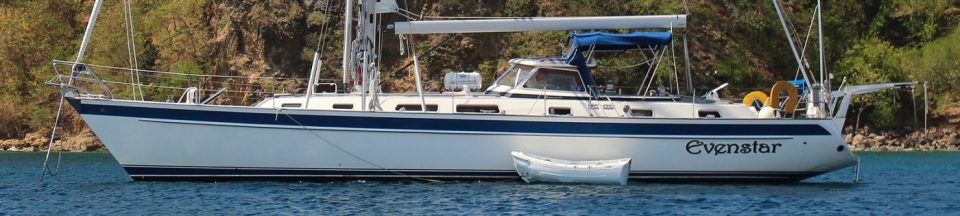
Two Years and 10,000 Miles
We’ve recently passed a couple of major milestones in our trip, which of course we largely forget to commemorate ourselves so we didn’t make a big social media production out to them either.
Two Years
It was July 22, 2012 at 4:30 in the afternoon that we cast off our lines from Brewer’s Marina in Warwick, RI and left our home waters permanently. Sure, we only sailed about eight miles down the bay that night but that was it, we were on the move, on the hook and on our way. While we’ve been back to Rhode Island twice since that date – once while sailing back from Maine to the Chesapeake and once by airplane from Panama last holiday season, that date was significant because it meant we were done with all our preparation and were ready to begin the adventure.
The last two years have gone by quickly, in some ways it seems like just yesterday we were throwing off the lines. But then, returning to the U.S. a few months ago our old home didn’t feel like “Home” either. Coming home was returning to Evenstar, no matter where she was.
10,000 Miles
I’ve talked before about how cruisers measure and count miles. What REALLY counts for experience when it comes to miles sailed? Does sailing back and forth from East Greenwich to Block Island (about 70 miles) for or five times a year for 6+ years really equal the experience of one 1,500 mile trip that takes you eight and a half days? Tough to say; we never saw more than 30 knots of breeze sailing to the Caribbean; the most wind I’ve been in still to date was a 60+ knot squall that caught us in whiteout conditions on the way to Block Island.
So yeah, I can add up thousands of miles of travel before we Left On The Big Trip. Enough sea time to qualify for a USCG Masters license, yada, yada, yada. So what, that was then…this is now. THIS trip, with THIS family and THIS boat we passed the odometer through 10,000 miles of travel right before we arrived in the Tuamotu Archipelago in French Polynesia. A lot of that is “long miles” – multi day passages with overnights, which is something a lot of people don’t do if you don’t live on board and take these sorts of trips. A lot of it is also short hops – a handful of miles from one anchorage to another, a thirty or forty mile day sail between islands, or even backtracking to return to someplace cool another time.
We reset the odometer to Zero on July 22, 2012. As the crow flows we’ve come almost 5,400 miles from our house in Warwick. With 10,000 miles of sailing, it’s not exactly been a straight and direct path. There’s been a lot of diversions, a lot of exploring. But that is kind of the point.
So What’s Next?
So where to from here? How long do we keep on going?
The answers are still the same – we’ll go as long and as far as we can. Sadly we’ve only got Will with us another year before we have to give him up to go to college. It seemed so far away when we left.
In the meantime we’ve got a Visa to be in French Polynesia through November. November is also when you want to clear out of here for the cyclone season; we plan to be in New Zealand before that rolls around. That is another 2,000 to 3,000 miles of sailing depending on what route we take. It will take us to the Society Islands and Tahiti, from there the questions is how to make the trip to New Zealand…directly, or through stops at more exotic locales like Niue, Tonga or others. this is still all To Be Determined.
In August we left the Tuamotus and sailed for Tahiti, where we had a big box of boat parts heading for us. We spent some time making repairs and getting re-organized and re-stocked and ready for some friends to visit. We had a lovely visit with them that took us down to Bora Bora and the other end of the Society Islands. When they left we took the next weather window back to Tahiti so Will could take the SAT.
After that we start working our way to New Zealand. With the SAT behind us, we are starting to get ready for more heading West. In the next two weeks we will be prepping the boat and looking for our weather window, then setting sail for New Zealand for the cyclone season.
Apologies Are In Order
I would like to take a moment to apologies to all my readers for my absolutely abysmal blogging track record since July. We’ve seen and done awesome stuff since we arrived in French Polynesia and I’ve been sharing next to none of it except for some pictures and cryptic comments on Facebook. There have been some excuses, such as the power supply in my computer dying on me. That means I’ve needed to get the backup laptop setup and running with all my tools on it, and there are still some pictures from places like Nuka Hiva and Makemo trapped on the hard drive until I get it working. That’s a big factor in it.
A lot of our time here is totally “Off the Grid” too, with no Internet access. That is much less of an excuse, as we DO go places with internet. Even though it is expensive we have it up for the kids to do school enough time for me to get my act together. It’s easy to get out of the blogging habit – even this post has been “in the can” for almost three months…I just forgot to finish it!
And I promise I will catch up, but I’m going to have to either skip some places and come back to them or post them without pictures. I’d rather wait for the pictures, but that could be my inner lazy talking.


 The prison conditions were brutal, with insufficient food and medicine for men put to work in the scorching sun and forced to do pointless, back-breaking labor. The death toll was high before the prison was finally closed in 1959.
 The first one was cleverly concealed on the side of the road and we almost went zipping past him. Fortunately a group of French bicyclists has stopped and were taking pictures which helped us spot him in the deep camouflage. He was quite patient with all the fuss and very accommodating to photos.


 With the light misting rain it was cool and comfortable walking, and most of the vertical ascent was made in the bus. Our only real concern was the fog; as we climbed we were in the clouds and could barely see 50 yards past the edge of the path. Fortunately by the time we reached the rim of the caldera this all changed, with a surprising rapidity the go lifted unveiling the stunning views of the surrounding lowlands.

 quite alive and active. The eruption left a large area on one side of the volcano almost sterilized. Lava flowed down one side of the volcano and left the far edge pretty much alone; it remains covered in lush vegetation.
 The landscape here is surreal, after the lush foliage of the walk up the ground changes rapidly to mostly uncovered stone with sparse and scrawny growth. There were several flows of different ages in this area and they can be easily differentiated by the color of the rock. The older – as in thousands of years older – flows are dark and the newer flows from 2005 are red. Different colors abound though and there is a stark beauty in this vast blasted landscape. From the top you can see how the lava flowed down miles all the way to the sea.


 Unlike the lava tubes we visited on Santa Cruz the lava tubes and tunnels we visited on the South coast of Isabela are mostly collapsed. This lead to broad coastal area full of narrow channels, stone bridges, rocky out crops, canals and barrow channels. The captain…picked his way through this in our roughly 26 foot cruise boat with incredible skill.

 ven without turtles and sharks the tunnels were a fascinating place to snorkel. The land bridges in evidence in the boat tour also extended under water. Fascinating underwater shapes to swim around and under abound, while watching the colorful fish and looking out for turtles and other sea life.
 The arches and bridges provide their own challenges to swim under or around. To reach one of the shark viewing angles required going under an arch – or way around it. This was followed by a swim/wriggle across a shallow top of some structure that left you knowing what it felt like to be the fish flopping on a dock.


